What if Your Backpack Held a Tiny Room?
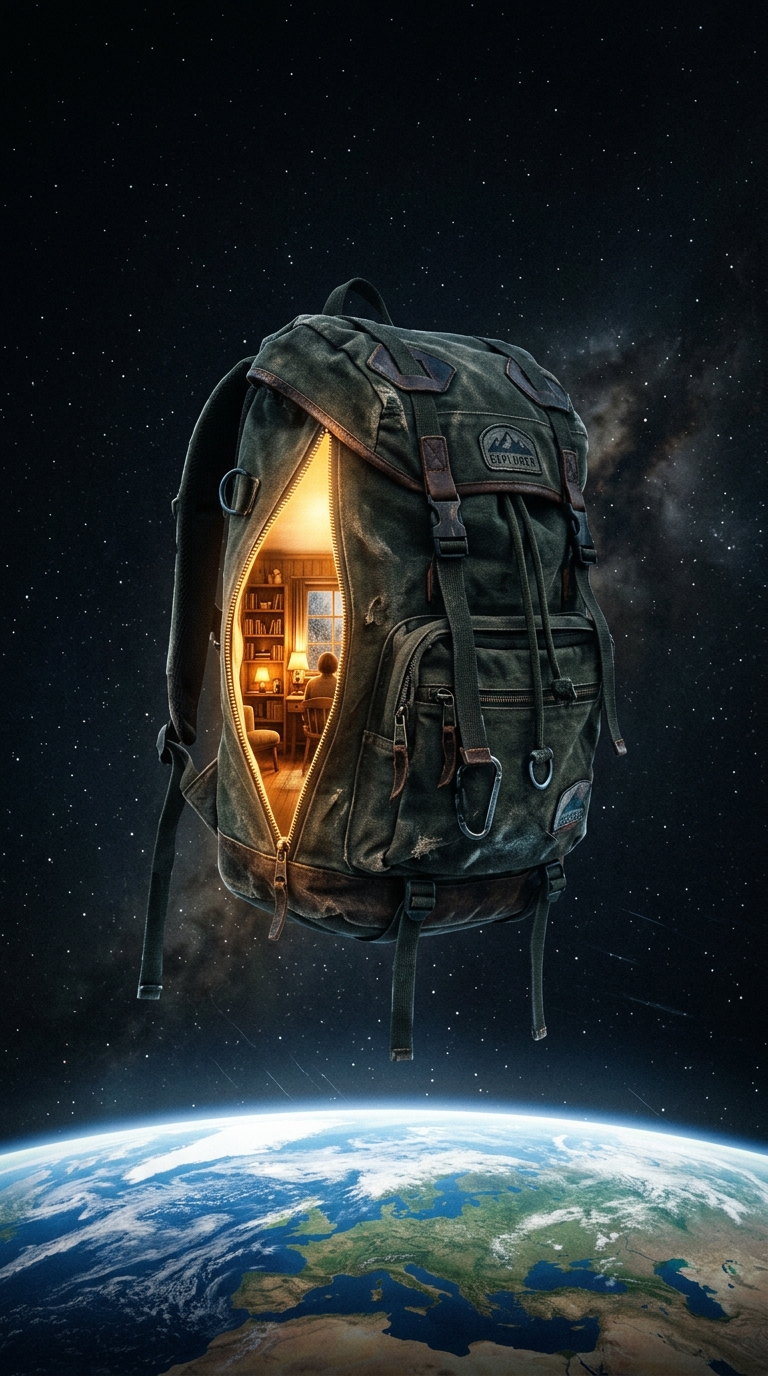
You unzip your backpack and the opening doesn’t reveal crumpled paper or a lost granola bar. It reveals depth. Not “extra pocket” depth. Real depth, like you could stick your head in and feel air move past your ears, like the zipper has become the frame of a doorway into a tiny, quiet room.
The first visible change is almost disappointingly domestic. Light spills out at an angle that doesn’t match the sun. The fabric around the zipper looks normal, but the space inside ignores common sense. If you toss in a pencil, it doesn’t thud against the bottom. It falls for a full second. Maybe two. You hear it land somewhere far away with a soft, carpeted tick. That sound alone would make half the internet accuse you of faking it with editing.
Now the physics starts sharpening its knives. A “room” is not just empty space. It has volume, air, pressure, temperature, and an inside surface area. If the room is, say, three meters by three meters by two and a half meters tall, you’ve just added about twenty two cubic meters of air to your backpack. At sea level, that’s around twenty six kilograms of air. You are carrying the mass of a small person’s worth of atmosphere in a book bag. Unless something even weirder is happening with gravity and inertia, your shoulders should immediately resign.
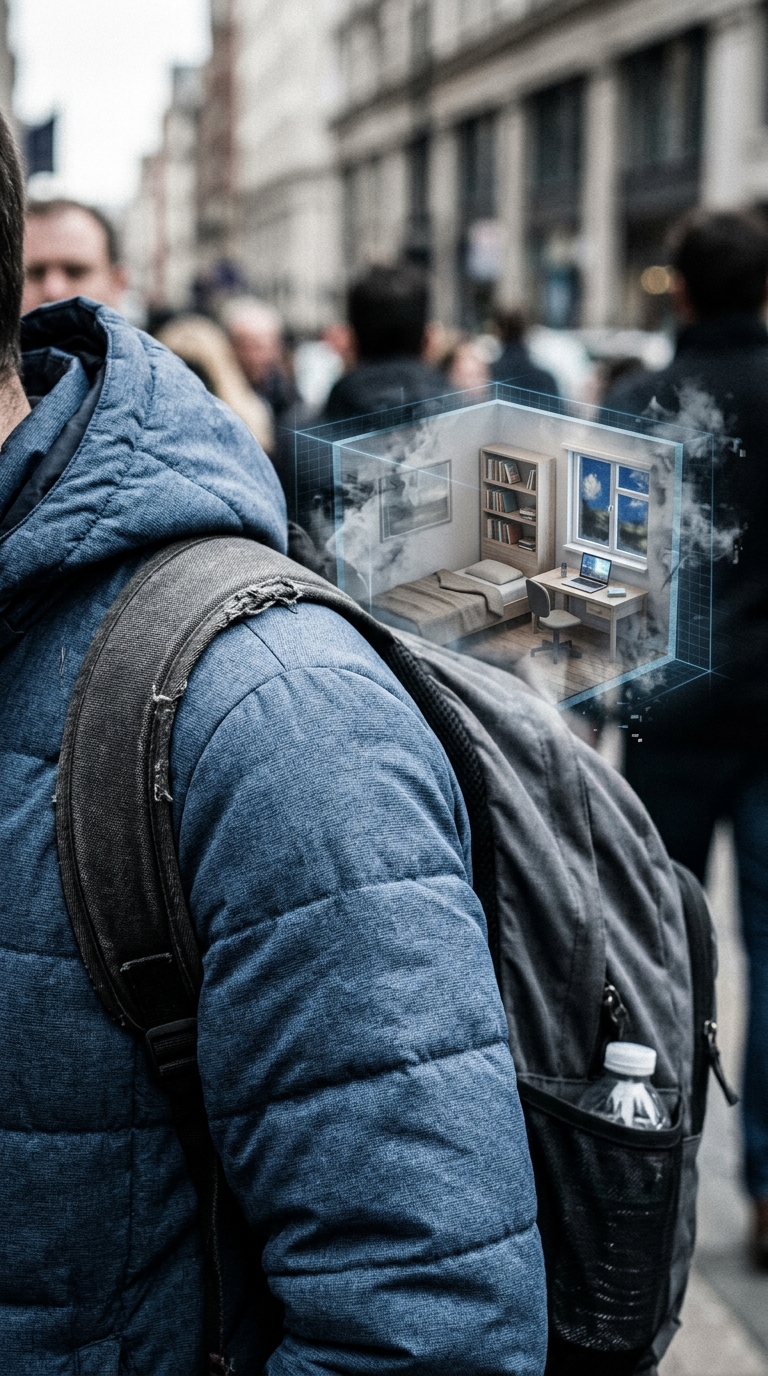
So either your backpack becomes brutally heavy, or the room’s contents are somehow “decoupled” from our universe’s inertia. That decoupling is the true magic. It’s not the extra space. It’s the fact that you can swing a backpack containing a bed, desk, books, and a lamp without dislocating your spine. If inertia is suppressed, you’ve invented a technology that would make rockets cry with joy. Reaction mass becomes negotiable. Fuel tanks become almost irrelevant. One weird backpack, and suddenly the most expensive part of space travel, hauling mass out of Earth’s gravity well, starts to look like a solvable engineering problem.
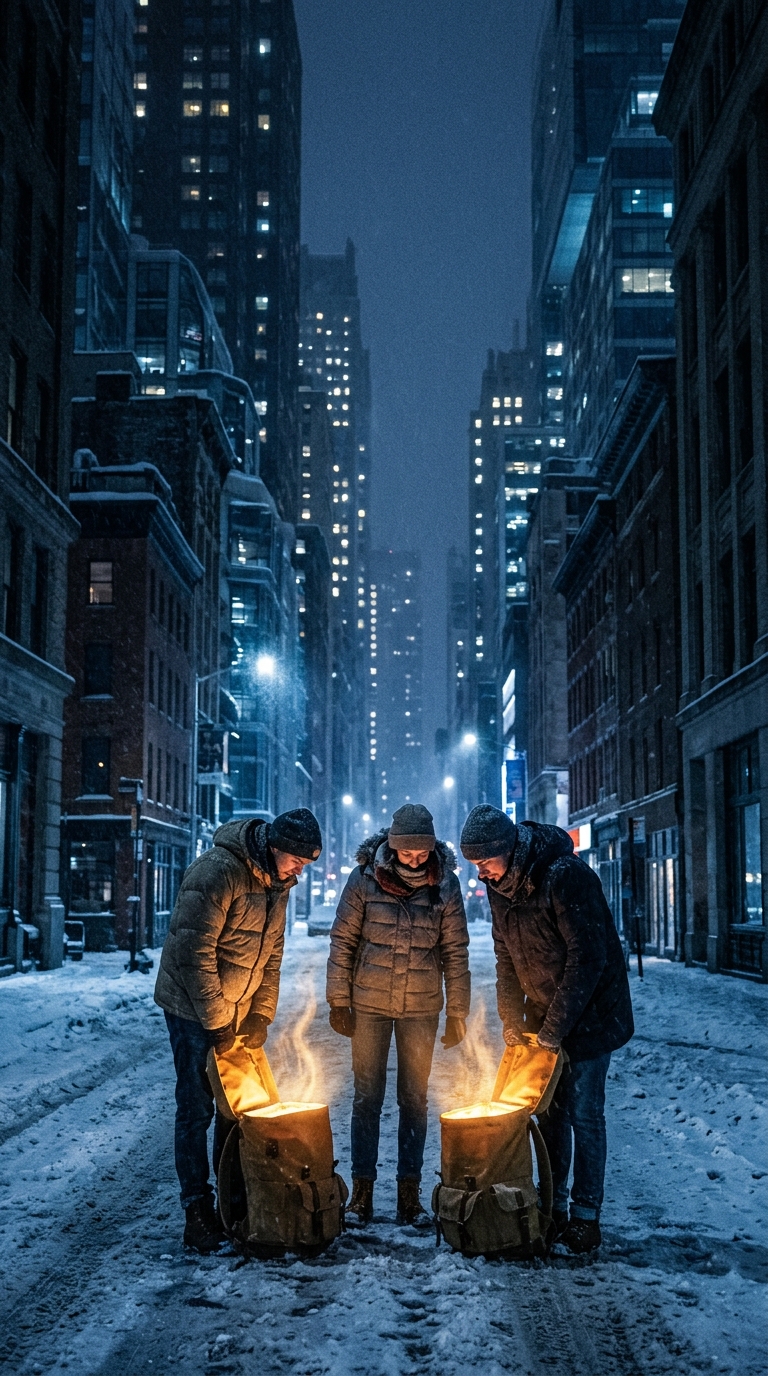
But even if we grant you the gentler version, “the room doesn’t weigh what it should,” there’s still the question of the doorway. Doorways are boundaries. Boundaries are places where energy leaks. If the room has its own temperature and you open it on a winter street, warm air will rush out, cold air will rush in, and condensation will instantly paint the zipper teeth with frost. If you open it in a humid summer, the room will drink moisture and fog like a cold soda can. Leave it open long enough and you’ve basically built a portable weather maker.
And then there’s oxygen. A tiny room with no vents is a fancy box. Sit inside, breathe, and in an hour you’ll feel sluggish as carbon dioxide climbs. Add a candle and you’ve made a self-extinguishing, headache-generating science experiment. The first rule of backpack rooms would be: ventilation, or at least an oxygen monitor. The second rule would be: do not fall asleep in there unless you like waking up as a cautionary tale.
Biology gets interested fast. A closed, warm space is a petri dish with furniture. Every time you climb in, you bring skin cells, bacteria, fungi spores, and whatever your shoes stepped on. Within days, that room develops its own smell. Within weeks, it develops its own microbiome. If you store food in there, you’re running a tiny ecosystem. If the room’s time flows differently, which is a common trick in stories, then a sandwich left “overnight” might come back as an archaeological dig. If time runs faster inside, you could accelerate composting, fermentation, even plant growth. If it runs slower, you’ve accidentally built the world’s most convenient refrigerator. Either way, your backpack becomes a biological device, not just a storage hack.
Now society notices. Not because it’s cozy. Because it’s a smuggling nightmare. A room-sized volume that fits in carry-on luggage is customs’ new sleep paralysis demon. Airports would respond the way they always do, with rules that are both intense and slightly ridiculous. “Please remove all rooms from your backpack and place them in the bin.” The first black market would be banal: luxury micro-apartments for commuters. The second would be terrifying: transporting contraband, weapons, people. The third would be subtle: data centers. If you can shove a room inside a backpack, you can shove a server rack in there. If the room’s thermal behavior is weird, you might even evade heat detection. That’s not magic anymore. That’s a geopolitical problem.
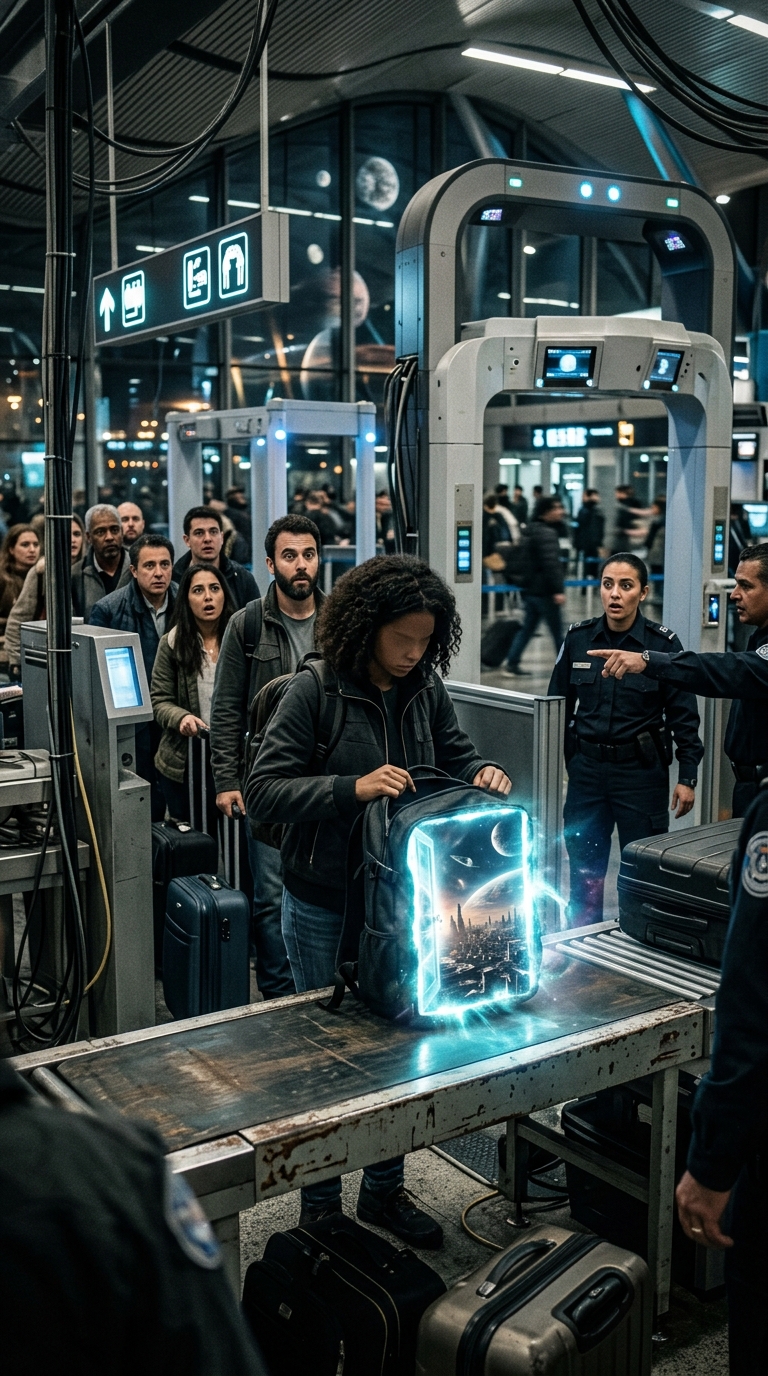
Daily life would bend around it. Schools would ban them, then quietly buy them. Offices would offer “backpack room allowances” instead of desks. Cities would see a rise in “portable solitude,” which sounds sweet until you realize it changes public spaces. Parks become quieter, or emptier. Why sit on a bench when you can sit in your own tiny room with perfect lighting and no one chewing with their mouth open. I admit, that last part is tempting.
There’s also the simple matter of safety. A zipper-door is a door you can accidentally close. What happens if you’re inside and someone zips the backpack shut. Does the room keep existing with you in it. Is there air exchange. Can you open it from the inside. If not, this is a horror story waiting for a prankster. Backpack rooms would need interior latches, emergency beacons, and probably a regulation that says children cannot operate zippers unsupervised, which is both funny and absolutely something we would do.
Climate enters through the back door. If the room exchanges heat with our world when opened, people will start using it like a thermal battery. In winter, you heat the room at home, close it, carry it outside, open it on a bus stop, and you’ve released stored warmth. In summer, you chill it and carry cold around. Multiply that by millions, and you’ve invented portable HVAC. The overall energy still has to come from somewhere, but the ability to move heat efficiently would change power grids and urban design. Cities might run fewer heated public spaces if everyone carries private warmth. That’s convenient, and also a little bleak.
Technology companies would rush to standardize the doorway. A zipper is quaint. They’d want airlocks, seals, pressure regulators, and “room skins” with programmable interiors. Architects would pivot from designing apartments to designing downloadable layouts. A friend of mine once spent a weekend rearranging furniture to feel like their life was changing. Now imagine rearranging the laws of interior space with a swipe. People would become connoisseurs of tiny-room vibes: library mode, studio mode, nap pod mode. Mental health apps would sell “anxiety rooms” with calibrated lighting and sound dampening. Of course they would.
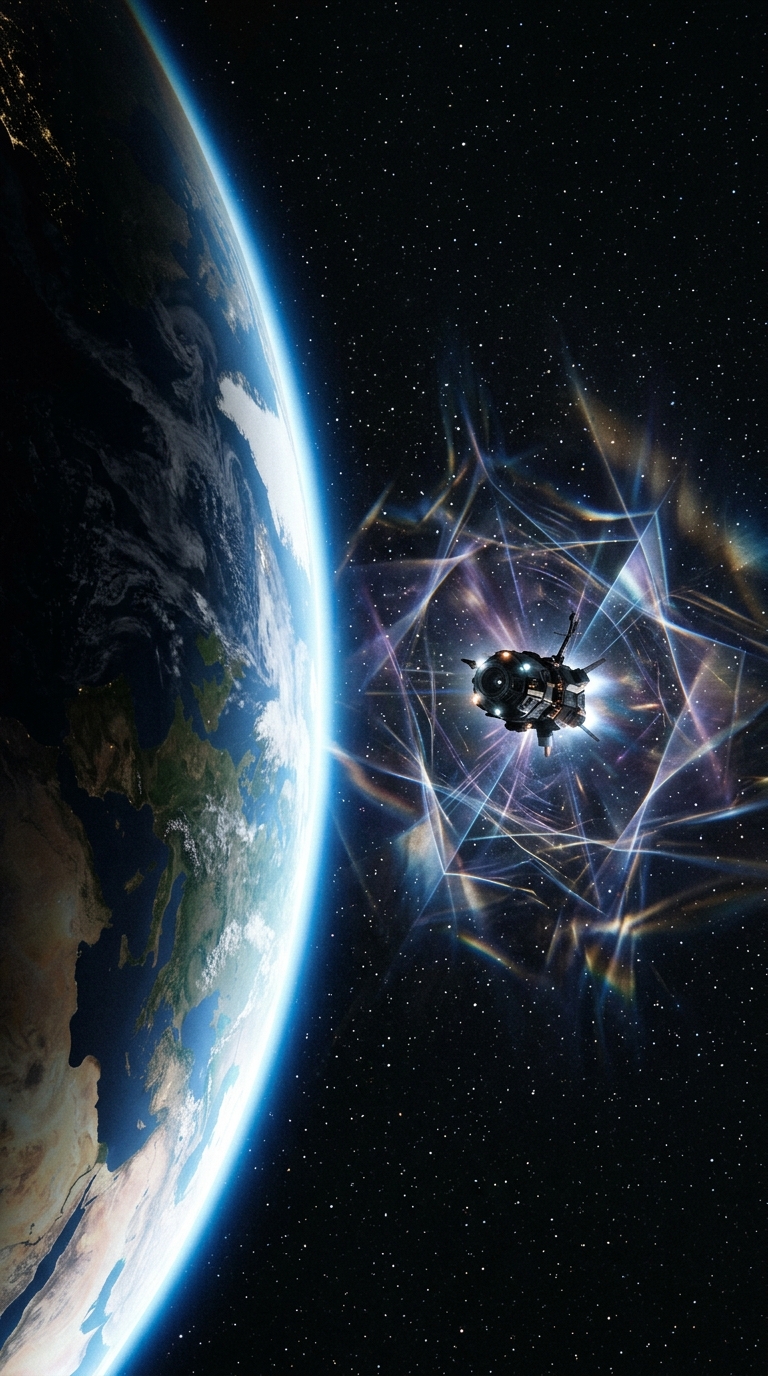
And then space. The biggest scientific consequence is that a backpack room is a working example of topology manipulation, the kind of geometry that normally lives in equations and not in your commute. If space can fold so that a large volume connects to a small opening, you are basically holding a controlled wormhole mouth. Not the interstellar kind necessarily, but the same family of tricks. That implies you can engineer spacetime. And if you can engineer spacetime, you can do more than hide a reading nook in canvas.
Psychology might be the quiet revolution. People don’t just want storage. They want control over boundaries. A backpack room is a private territory you can carry through the world. For some, it’s liberation: a safe space, a studio, a refuge from noise. For others, it’s avoidance: why learn to tolerate a messy world when you can retreat into a perfectly tuned box. Relationships might change. Arguments might end with, “I’m going to my backpack,” which is objectively funny the first time and devastating the tenth.
The biggest unexpected consequence isn’t that you could nap anywhere. It’s that once you prove a room can fit through a zipper without bringing its mass along for the ride, you’ve proven the universe is negotiable at the level of geometry and inertia. The cozy mini room is just the friendly user interface. The real invention is portable, controllable spacetime, and the first serious application won’t be reading or drawing. It’ll be shipping, warfare, and spaceflight. Your backpack starts as a hiding place for peace and quiet. It ends as the door handle on an entirely new kind of physics, and doors, historically, don’t stay private for long.
Loved this story? Pulse it.
Pulses bubble up to the channel — they help us see which stories deserve sequels.