What if Shoes Changed Color When Tired
The first time you notice it, it’s almost rude. You’re walking home, feeling fine in that vague, end-of-day way, and your shoes quietly betray you by blushing from a confident deep blue into a washed-out gray-green. Not a fashion choice. Not a lighting trick. A real-time, undeniable “you’re tired” signal, strapped to your feet.
In the immediate aftermath, life becomes weirdly theatrical. People start glancing down instead of up. A friend asks, “Want to keep going?” but their eyes are on your soles, not your face. Joggers look like living progress bars, shoes bright at the start, then dimming toward a sickly hue around mile four. Commuter platforms turn into little color-coded weather maps of exhaustion, a tide of pale tones rolling in as the day drains everyone at once.
To make shoes “change color when tired,” you need to define what tired means in measurable signals. The most straightforward version is physical fatigue: the muscles in your legs begin producing more metabolic byproducts, your gait subtly changes, your skin temperature shifts, and your sweat chemistry evolves. All of those are quantifiable. Modern wearables already infer fatigue using heart rate variability, motion patterns, and skin conductance. A shoe has an advantage because it sits at the interface where your body’s effort meets physics: ground reaction force, pressure distribution, and micro-slips.
So imagine a near-future shoe with a thin sensor mesh in the insole. It samples pressure maps at hundreds of points, measures tiny changes in stride symmetry, and tracks impact force. As you tire, your steps get less springy and more “flat.” Your cadence wobbles. Your dominant leg starts cheating. The shoe also measures temperature and moisture at the foot. Then a little on-board model estimates fatigue, and the outer surface uses electrochromic materials, like the stuff behind smart windows, to shift color. It’s not magic. It’s mood lighting for biomechanics.
The scientific chain reaction starts with how humans respond to feedback. Give someone a mirror, and they stand up straighter. Give them a constant fatigue indicator, and they begin negotiating with themselves in real time. Some people will push harder out of stubbornness, turning the shoe into a taunt. Others will finally grant themselves permission to rest, because now there’s “evidence.” I once used a step counter that buzzed at me to move, and I swear I felt personally attacked by a plastic rectangle. Shoes that publicly announce fatigue would feel like that, but with witnesses.
Physically, the potential upside is huge. Fatigue is a major factor in injury. Ankles roll when stabilizer muscles get sloppy. Knees take weird angles when form collapses. Falls happen when attention drifts and legs stop lifting as high. If your shoes shift to amber before you feel wrecked, they become early-warning beacons. Workplaces with high injury rates, like warehouses or hospitals, would quietly love it. The shoe becomes a safety device, like a hard hat that changes color when your brain is overheating.

But now the social systems kick in, and they don’t always behave like safety manuals. Employers start asking, “Why were your shoes red at 3: 40 p.m.?” Coaches recruit by watching warm-up colors. Dating gets… efficient in the worst way. “He said he was energized, but his shoes were basically beige.” Schools notice which kids arrive already faded, and suddenly tiredness becomes a visible socioeconomic marker. You can hide a yawn. You can’t hide glowing footwear in a hallway.
And yes, people will try to hack it. There will be “freshness sprays” that cool the sensor area to spoof lower fatigue, compression insoles that alter pressure maps, and aftermarket skins to mask the color. A black market for counterfeit “always-blue” shoes pops up fast, because humans have a deep need to look fine even when they’re not. Also because we’re petty. The first time a teenager figures out how to make their shoes flash neon green during gym class just to mess with the teacher, you’ll know this is a real technology.
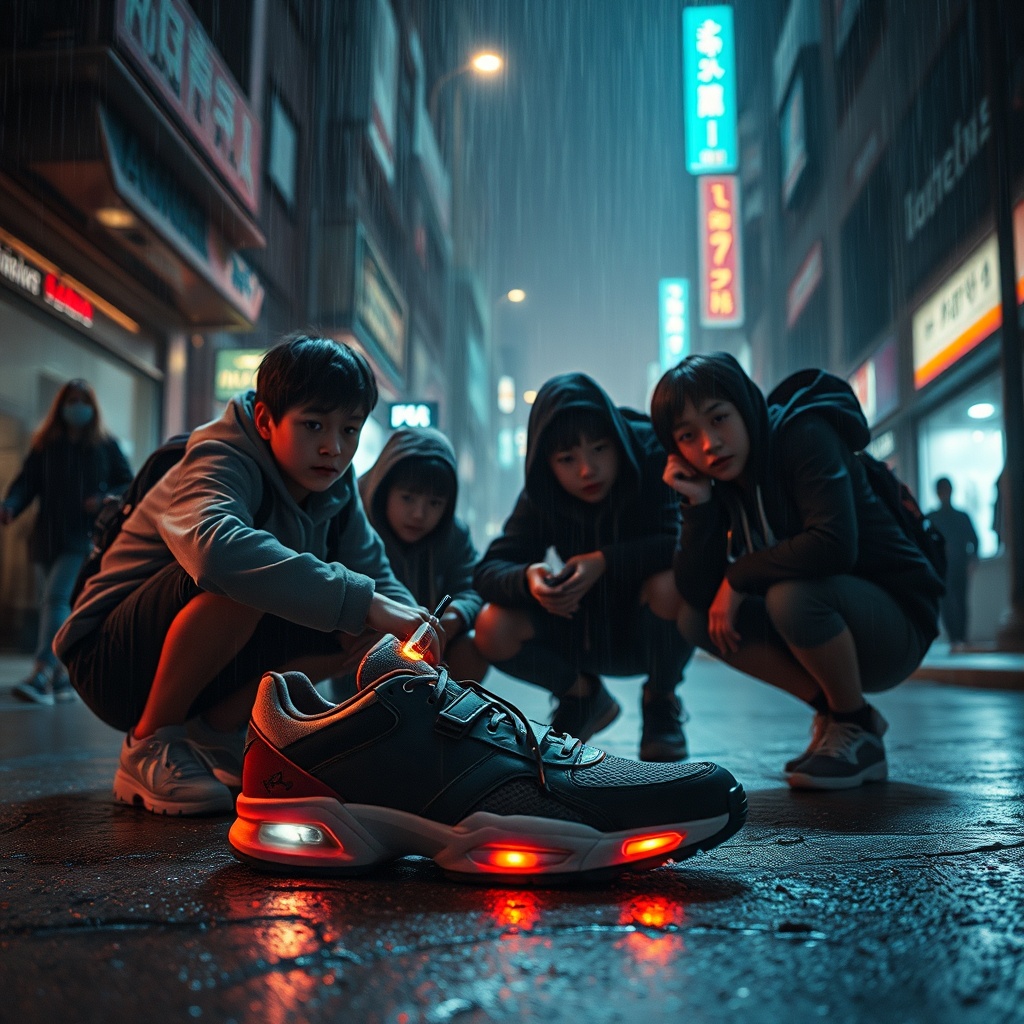
Psychology gets even stranger when fatigue becomes performative. People start pacing their day to stay in the socially acceptable color range. Break rooms become “recharge theaters,” where everyone sits, watches their shoes slowly crawl back toward a respectable shade, and then stands up at the same time like synchronized swimmers. Some will game their lives around it, optimizing sleep, caffeine timing, hydration, and walking routes to keep the color flattering. It’s wellness, but with a scoreboard.
Now, scale up. Cities begin to map public fatigue. Not by surveying feelings, but by counting color. Cameras already see shoes constantly. If aggregated, you could create real-time “tiredness heat maps” of neighborhoods. A transit authority might notice that a particular station always produces a spike toward exhaustion and realize the stairs are too steep, the escalators unreliable, the wait times long. Urban design gets a new metric: not just foot traffic, but foot fatigue.
That cascades into energy and climate in a subtle way. If people take fatigue cues seriously, they walk less when they’re depleted and choose micro-mobility, transit, or just rest. That could reduce some travel emissions. But the shoes themselves are electronics, and electronics have footprints. Manufacturing electrochromic skins, sensor arrays, and batteries at global scale means mining, refining, and shipping. The climate ledger becomes a trade-off: fewer injuries and smarter mobility, versus a new category of e-waste.

Technology responds the way it always does. It connects everything. Shoes talk to your phone. Then to your insurer. Then to your employer’s “wellness dashboard.” Then to the city. Then to the cloud model that updates the fatigue algorithm based on millions of bodies. The shoes stop being a simple indicator and become a behavioral interface. They might vibrate when you’re approaching risky fatigue. They might recommend a route with fewer hills. They might order you an autonomous ride when you cross a threshold. Helpful, until it isn’t.
And then comes the most cinematic leap: space. Astronauts already use meticulous fatigue monitoring because tiredness in microgravity isn’t just a feeling. It’s a safety hazard with expensive consequences. Imagine crew footwear that changes color inside a spacecraft, reflecting cumulative strain during spacewalk training or long-duration missions. In a habitat where everyone depends on everyone else, a visible fatigue signal could prevent disaster. It could also amplify tension. In a sealed metal world, nobody wants to be the one whose shoes are always paling first.
But the biggest unexpected consequence isn’t in orbit. It’s in the tiny, everyday shift in what we believe about ourselves.
When tiredness becomes visible, we stop treating it as a private, negotiable sensation and start treating it as a fact, like weather. That sounds empowering, and sometimes it is. People will rest earlier, get injured less, and maybe even sleep a little more. Yet the darker twist is that the color can become the truth, overriding your internal sense. You’ll feel okay, but your shoes disagree, and now you’re the unreliable narrator of your own body. Or you’ll feel awful, but your shoes look fine, and you’ll push through because the signal says you should.
The shoes were supposed to reveal fatigue. Instead, they redefine it. The most surprising consequence is that we’d hand over one of our oldest human skills, listening inward, to something outward and glowing. We’d gain a safety light. We might lose a little self-trust. And once your culture learns to judge energy by color on the pavement, it’s hard to go back to pretending we can’t see what everyone is carrying.
Loved this story? Pulse it.
Pulses bubble up to the channel — they help us see which stories deserve sequels.