
What if Your Coffee Cup Measured Stress

The first time your coffee cup tells on you, it won’t do it politely. It’ll do it like a mood ring with a PhD. You pour in the coffee, the ceramic warms, and a thin halo blooms around the rim. Calm might look like a pale, steady blue that barely shifts as the steam rises. Stress, though, arrives as jitter. The color breaks into ragged stripes, pulsing in time with your heartbeat. Maybe the cup even adds a subtle vibration, like a phone that won’t stop getting bad news.
At the kitchen table, you’d learn your “morning routine” has a diagnostic soundtrack. The cup’s outer wall could fog in speckled patches if you’re sweating more than usual. The handle might feel slightly tacky if your palms are clammy. If the system is designed to be unmistakable, it might project a faint pattern across the surface, rippling like heat shimmer, mapping a number you can’t unsee. People will swear they can tell their spouse’s stress level from across the room. They will be correct. They will also use this power for evil, like asking, “So. Big day?” in exactly the wrong tone.
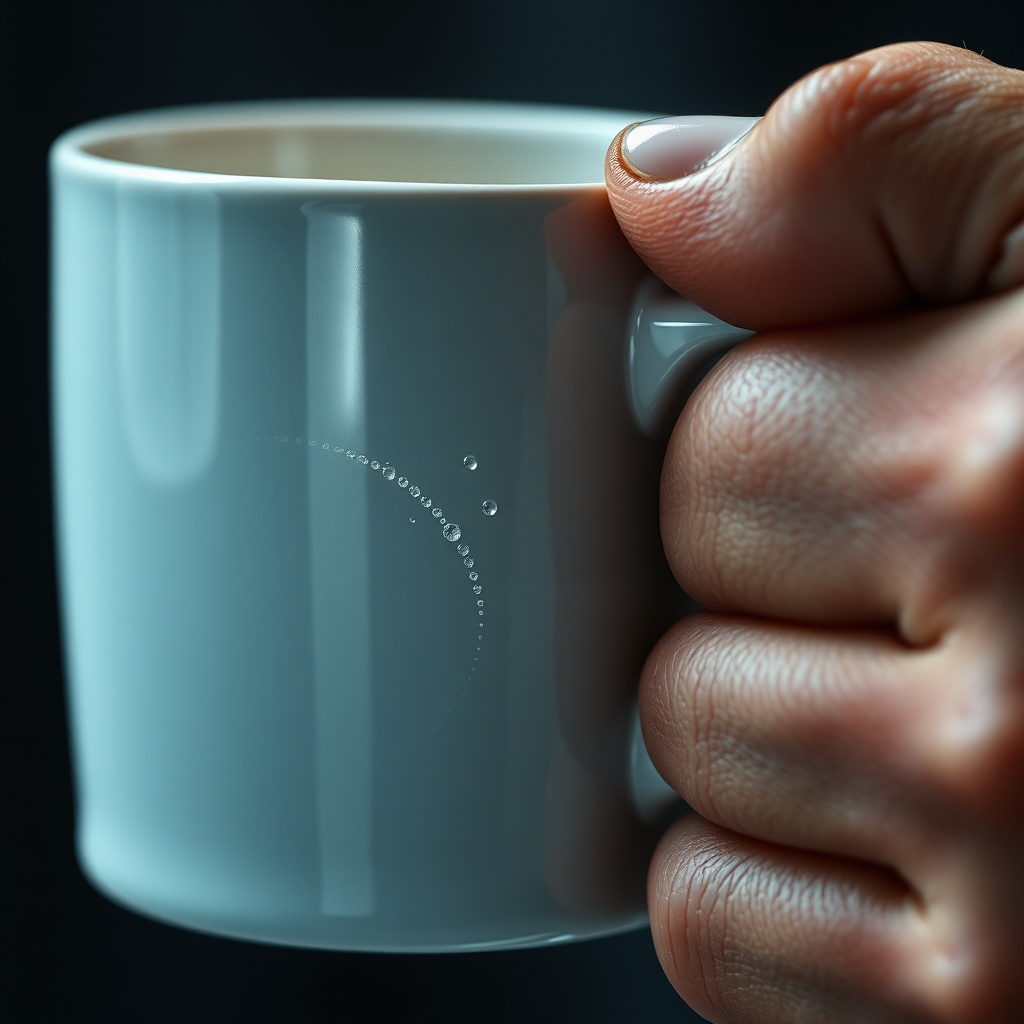
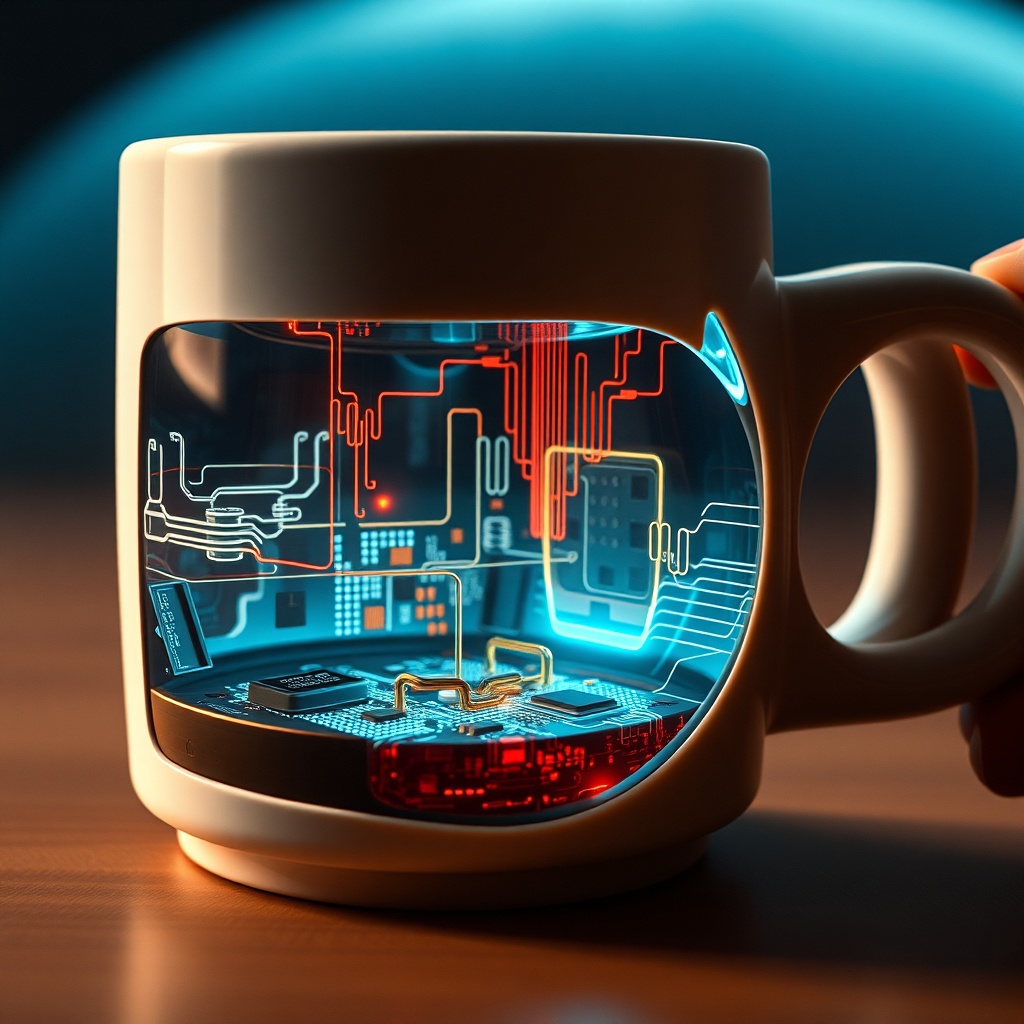
To make a cup measure stress, you don’t actually need mind-reading. You need biology’s exhaust. Stress leaves fingerprints all over the body: faster pulse, altered breathing, changes in skin temperature, sweat chemistry, grip pressure, micro tremors, even subtle shifts in how much heat you dump into the environment. A “stress cup” could be a dense sensor package hidden in an ordinary object. The handle is the obvious spot: it can read your pulse through photoplethysmography, the same trick smartwatches use, by shining light into skin and watching blood volume change. Add electrodes and you can estimate galvanic skin response, basically how sweaty you are at a microscopic level. Embed a tiny pressure sensor to gauge grip. Put a thermistor on the ceramic to track skin temperature. A microphone can catch breathing rate if you sip loudly, which many of us do, heroically.
Then the cup runs a model. Stress isn’t one signal, it’s a pattern across many. Caffeine can raise heart rate without panic, and exercise can look like anxiety if you only measure pulse. But combine signals and you can separate “I ran up the stairs” from “I’m imagining my inbox.” The physics is mundane but powerful: ceramic conducts heat, skin sweats salts, light scatters differently through oxygenated blood. You’re a walking weather system. The cup is a meteorologist.
The first chain reaction happens inside you. Stress measurement changes stress. If the cup flashes red, you might tense, which makes the cup flash redder, which makes you tense more. That’s a feedback loop worthy of a horror film, except it plays out in slippers. Psychologists call it interoceptive amplification: paying attention to bodily signals can intensify them. For some people, seeing a high score would prompt regulation. They’d breathe, slow their exhale, watch the color cool toward blue, and feel a little victory before commuting. For others, it becomes a tyrant on the counter. “Why am I stressed. I’m stressed about being stressed.” The cup, silent, does not care.
Biology will oblige either way. Chronic stress pushes cortisol and adrenaline patterns that shift sleep, appetite, immune function. If the cup catches it early, it could nudge behavior in a healthier direction: take a walk, delay that third espresso, actually eat breakfast. But it could also turn your morning into a lab experiment you didn’t consent to. I’ve known people who can’t wear a sleep tracker because it makes them sleep worse. This would be that, but with caffeine involved, which is like giving the experiment a megaphone.
Now widen the lens to society. The stress cup quickly stops being a private mirror and becomes a social instrument. Couples will negotiate whether the cup is “allowed” at breakfast. Roommates will accuse each other of “weaponizing the mug.” Offices will try “wellness coffee stations” where company-issued cups glow green for calm. That sounds supportive until the first manager says, “Interesting. Yours is always orange on Mondays,” and everyone laughs too loudly.
The data question arrives immediately. If the cup is connected, someone will want the stream. An insurer will offer a discount if you share your “morning resilience metrics.” A productivity app will promise to “optimize your schedule” based on stress readings, which is a nice way of saying it will move your hardest meetings to the days you seem least likely to scream. Employers won’t need to demand it outright. They’ll just make the “optional” cup the one that gets free coffee.
Even if the cup never uploads a single byte, humans are excellent at surveillance without Wi-Fi. Stress becomes visible. Visible stress becomes judged. People start hiding it, like hiding a messy house before guests arrive. There will be black-market sleeves that spoof readings, insulating the sensors or feeding fake pulse patterns. Someone will sell “calm glaze,” a coating that keeps the cup serenely blue no matter how your heart jackhammers. The most stressed people will become the most invested in appearing calm. That is not an accident. That is the system doing what systems do.

Technology responds by escalating. Version one measures your stress. Version two tries to change it. The cup warms its handle to activate comfort receptors in your skin. It releases a micro puff of lavender scent. It modulates the rim temperature to slow sipping, because slower drinking can nudge breathing patterns. The cup becomes a behavioral therapist you can wash in the dishwasher. Your phone, jealous, syncs to it. Your smart speaker suggests music based on the color. By the time you reach the car, your day has already been nudged by an object that used to be inert.
There are also climate and energy ripples, small but real. If millions of cups add electronics, batteries, and wireless chips, you’ve built a whole new class of e-waste. The greenest stress cup is probably the dumbest one: a passive thermochromic glaze that changes color with skin temperature and grip heat. But passive systems are cruder, and crudeness leads to misreads, and misreads lead to arguments, and arguments lead to more coffee. Somewhere, a power grid operator notices a new pattern: a synchronized spike in kettle usage at 7:18 a.m. after everyone saw their mug glow “high stress” and decided they needed another cup. Humanity has done stranger things with less motivation.

The strangest consequences show up when this idea leaves Earth. On a spacecraft, stress is not just a feeling. It’s mission risk. A stress-sensing cup in a habitat could help catch interpersonal tension before it becomes a real operational problem. You don’t want to discover someone’s spiraling when they’re doing a spacewalk. But you also don’t want a device that broadcasts vulnerability in a place where privacy is already scarce. In a sealed environment, everyone already shares air. Do they now share emotions by color code too.
Back on the ground, the psychology evolves. People learn to perform for the cup. They develop rituals that “cool the halo.” Morning breathing becomes as automatic as brushing teeth. Some households treat the cup like a traffic light: green means jokes, yellow means gentle, red means don’t bring up money. That’s not entirely bad. It’s a new emotional language, and language can reduce conflict. But it can also replace honest conversation with a shorthand. Instead of saying, “I’m scared about my presentation,” you point at the mug and shrug. The cup becomes the scapegoat and the translator, and you slowly forget how to speak without it.
The biggest unexpected consequence isn’t the tech, or the data, or even the awkward breakfast negotiations. It’s the way a simple object rewrites what you consider normal. Once stress has a color, you start treating calm as the default and stress as a failure, rather than a signal. You stop asking, “What is my mind trying to protect me from,” and start asking, “How do I get the number down.” The cup was supposed to measure you. Instead, it trains you. And one morning, when it finally glows a perfect, serene blue, you may realize you’re not calm. You’re just very, very good at hiding from yourself.
Loved this story? Pulse it.
Pulses bubble up to the channel — they help us see which stories deserve sequels.