How the World United for Space Safety
A strange thing happened when humans first started throwing metal into the heavens. The sky, which had always belonged to myths and weather, suddenly needed rules. Not later. Not when the first disaster arrived. Immediately. Because once you can reach orbit, you can also reach your enemy, and the difference between a satellite and a weapon can be as thin as a wiring diagram.
The story people usually remember is the spectacle, the beeps, the grainy photographs, the flag-planting. The quieter story is paperwork, meetings, and uneasy handshakes in fluorescent-lit rooms. But that second story is why space didn’t become the Wild West by default. The international law you’re thinking of is real, and it grew out of the tensest decades of the twentieth century, when the world was split into rival blocs and still decided, somehow, to set ground rules for the cosmos.

In October 1957, the Soviet Union launched Sputnik 1, and the sound of that little satellite, a steady radio pulse, landed like a psychological bomb. The device itself was small. The implications were enormous. If a rocket could place a sphere into orbit, it could also deliver a warhead across oceans. If it could pass over your territory without asking, then “sovereignty” had just met its first true vertical challenge. Where does a nation’s airspace end. Where does outer space begin. And who gets to decide.
The United States and the Soviet Union were the main antagonists of the era, but they were not alone in the room. The United Nations, still relatively young, became the stage where smaller states could push back against the idea that space would be carved up by whoever had the biggest engines. There was also an earlier precedent that mattered more than people realize. In 1959, Antarctica got its own treaty, setting it aside for peaceful purposes and science. It wasn’t a perfect analogy, but it was proof that even in the Cold War, the world could agree to keep at least one extreme frontier from becoming a military playground.
Outer space presented a more urgent version of the same problem, with higher stakes and faster timelines. The first human spaceflight, the first weather satellites, the first spy satellites, all arrived in the early 1960s like a sudden storm. With each launch, the question became less philosophical. If a satellite crashes. If debris rains down. If a nuclear device is tested in orbit. If someone claims the Moon. What then.
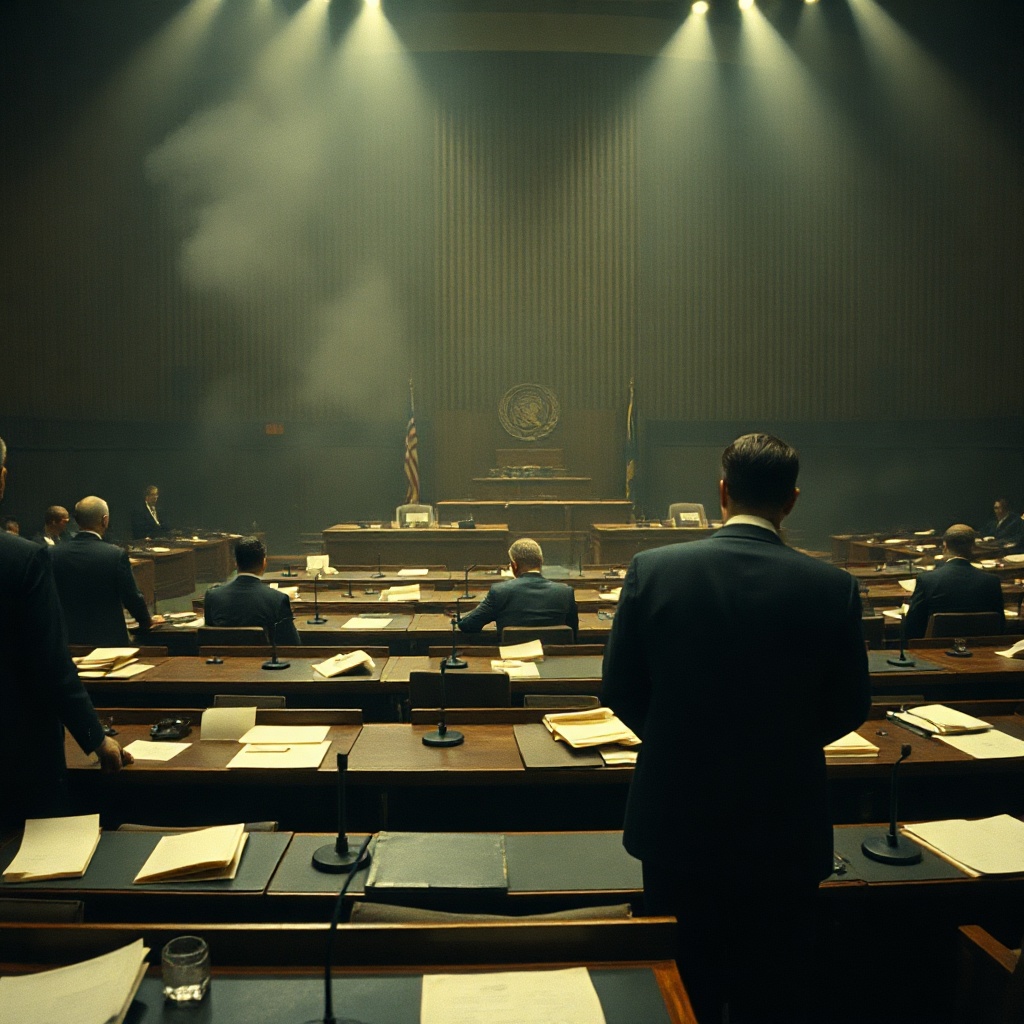
In 1959, the UN created a body with a clunky name and a critical job: the Committee on the Peaceful Uses of Outer Space, often shortened to COPUOS. This committee became the workshop where the legal skeleton of modern space activity was assembled. It wasn’t glamorous. It was bargaining, drafting, revising, and translating principles into sentences that could survive hostile interpretations.
Two superpowers loomed over every conversation, and yet the negotiations weren’t merely a U.S.-Soviet duet. Many other countries were watching and shaping the outcome. New independent states, emerging from colonial rule, were especially sensitive to anything that smelled like a new age of conquest. If land could be colonized, why not craters. If sea lanes could be controlled, why not orbits. The law had to shut that door firmly, or at least try.
By 1963, the UN General Assembly adopted a major set of principles, a declaration that sketched the moral outline: space should be explored and used for the benefit of all countries, outer space should be free for exploration, and celestial bodies should not be subject to national appropriation. Declarations are not treaties, though. They are promises with soft edges.
The hard edges arrived a few years later.

In 1967, the Outer Space Treaty entered into force. Its full name is longer and more formal, but the nickname is the one history kept. It became the foundation of international space law, and it did something remarkable for a document born in an era of nuclear dread. It set outer space, including the Moon and other celestial bodies, apart as a realm where certain old habits were forbidden.
First, it said that outer space is not subject to national appropriation. No planting a flag and claiming ownership. No declaring a lunar province. No “finders keepers” for planets. Second, it required that exploration and use be carried out for the benefit and in the interests of all countries, and that space be the province of all humankind. That phrase has a lofty ring, but it had teeth. It was a rebuke to empire, translated into spaceflight.
Third, and crucially for “space safety,” it prohibited placing nuclear weapons or other weapons of mass destruction in orbit, installing them on celestial bodies, or stationing them in outer space in any other manner. It also limited military activity on the Moon and other celestial bodies, requiring they be used exclusively for peaceful purposes. Notably, it did not ban all military uses of space. Spy satellites, for instance, were not explicitly outlawed, and they quickly became part of the Cold War’s strange stability. Watching your rival can, perversely, reduce the temptation to strike blindly.
The treaty also made states responsible for their national activities in space, whether carried out by government agencies or non-governmental entities. That point, which sounded almost theoretical in 1967, now sits at the center of modern space policy. Today’s world of private launch companies and commercial mega-constellations lives inside that sentence.
Responsibility has consequences, and the world had to add more tools to the legal kit. In 1968 came the Rescue Agreement, dealing with the assistance and return of astronauts and space objects. In 1972, the Liability Convention clarified what happens if a space object causes damage, especially on Earth. In 1975, the Registration Convention pushed transparency, requiring states to provide information about objects they launch into outer space. These later treaties don’t get the same spotlight as the 1967 pact, but they are the nuts and bolts that turn lofty principles into something you can argue in a courtroom or a diplomatic note.
If you’re wondering whether these laws were written in some pure spirit of brotherhood, the honest answer is that self-interest played a starring role. The United States and Soviet Union both wanted to avoid misunderstandings that could trigger war. They also wanted predictable norms so that their own programs could operate without endless crisis. Cooperation, in this case, wasn’t a group hug. It was a guardrail.
And it worked, at least in the sense that there has been no open national land-grab of celestial territory recognized under international law, and no acknowledged deployment of weapons of mass destruction in orbit. That is not nothing. When I think about how many human institutions buckle under pressure, it’s almost suspicious that this one held. Almost.

But space safety today has a new face. It’s less about mushroom clouds and more about junk. Thousands of satellites now share orbital highways with dead spacecraft, spent rocket stages, and fragments from past collisions and anti-satellite tests. The Outer Space Treaty doesn’t give a detailed traffic code for avoiding debris. It doesn’t fully anticipate the scale of commercial activity. It says states bear international responsibility, but how states regulate private actors varies widely. The old framework still matters, but it creaks.
There’s also the persistent ambiguity of what counts as “peaceful.” Many countries interpret it as “non-aggressive,” not “non-military,” which is why military satellites are common and often accepted. That ambiguity was probably the price of agreement in the 1960s. Treaties are often like that. They are engineered to be signed.
Another consequence is philosophical, and it’s easy to overlook. The treaty established the idea that space is a shared domain governed by international norms, not simply an extension of national territory. This concept has influenced everything from scientific collaboration to how we talk about the future of mining asteroids. Even the arguments that challenge the treaty’s spirit are forced to argue against it, which is its own kind of victory.
People still talk about the Outer Space Treaty because it’s one of the rare moments when the world looked at a new frontier and, before the worst habits set in, tried to write a code of restraint. It didn’t solve every problem. It couldn’t. But it made space law a real thing rather than a polite fantasy. In an age when more actors, more money, and more machines are pouring upward every year, that thin line of 1967 language still hangs above us like an old promise: the sky is not a battlefield by default, and the dark beyond the atmosphere is not supposed to belong to whoever gets there first.
Loved this story? Pulse it.
Pulses bubble up to the channel — they help us see which stories deserve sequels.